Return to player and lottery prize funds
Return stated per unit staked, why turnover rather than starting funds is the base, and how a draw game's return is fixed by its prize-fund share before any tier is designed.
Return stated per unit staked
Return to player is the proportion of the total amount staked that a game returns as prizes over a very large number of trials. It is the complement of the house edge: a game returning 96 % retains 4 %, and both figures are per unit staked. The base matters more here than anywhere else on this site, because return figures are routinely read as though they applied to the amount a player begins with, which they do not.
return to player  =  96 %          per unit staked
house edge        =   4 %          per unit staked

100 units staked         ->  expected loss  4.00 units
1,000 units staked       ->  expected loss 40.00 units

At 1 unit per spin and 600 spins in an hour, the amount
staked in that hour is 600 units, so

  expected loss per hour = 600 x 0.04 = 24.00 units      per hour

The same game is 4 % and 24 units per hour. Neither figure
is wrong; they are measured against different bases.
The gap between those two readings is the reason return figures can look reassuring. Amounts won are generally staked again, so total turnover across a period is a multiple of the amount brought, and expected loss tracks turnover. A game returning 96 % per unit staked will, given enough trials, absorb any finite starting amount, because the proportion applies to each unit each time it is staked.
Draw games: the return is fixed before the prizes are designed
A draw game works from the opposite end. Rather than setting prizes and deriving a return, the operator sets the share of stakes that goes into the prize fund and then divides that fund among tiers. If half of every amount staked enters the prize fund, the return is 50 % before any tier has been specified, and no arrangement of tiers can change it.
prize fund share      =  50 % of stakes
expected value of a ticket priced at 2 units

  =  0.50 x 2  =  1.00 unit         per ticket

The tier structure decides how that 1.00 unit is
distributed across winners. It does not decide its size.
Counting the selections
The tier structure is a counting problem. For a game choosing six numbers from forty-nine, the count of distinct selections is the number of ordered sequences divided by the number of orderings of six items, since order does not matter.
49 x 48 x 47 x 46 x 45 x 44   =  10,068,347,520
6 x 5 x 4 x 3 x 2 x 1         =            720

10,068,347,520 / 720          =     13,983,816 selections

  P(matching all six) = 1 / 13,983,816 = 0.0000000715   per draw
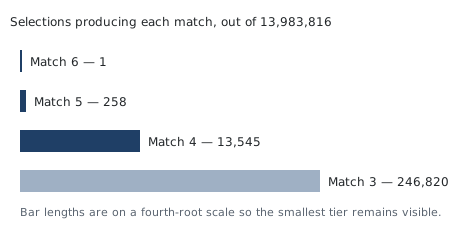
The lower tiers are counted the same way: choose which of the six drawn numbers a ticket matches, then choose the rest of the ticket from the forty-three numbers not drawn.
match 6 :  C(6,6) x C(43,0) =  1 x     1 =        1
match 5 :  C(6,5) x C(43,1) =  6 x    43 =      258
match 4 :  C(6,4) x C(43,2) = 15 x   903 =   13,545
match 3 :  C(6,3) x C(43,3) = 20 x 12341 =  246,820
                                            -------
  tickets winning something               =  260,624

  P(any prize) = 260,624 / 13,983,816 = 0.018637
               = about 1 in 53.7                        per draw
Pools rather than fixed odds
Draw games and pool betting share a structure. In a pari-mutuel pool all stakes are combined, a fixed share is deducted, and what remains is divided among the winning tickets in proportion to their stakes. The deduction is the return figure in another guise: a pool deducting 20 % returns 80 % per unit staked, whatever the result and whatever the distribution of stakes across outcomes.
This has one consequence worth stating. In a pool, the price is not known when the stake is placed, because it depends on how everyone else's stakes are distributed at the close. In fixed-odds betting the price is agreed at the time of the stake and the layer carries the risk of the result. The two arrangements distribute risk very differently and produce the same kind of figure: a fixed proportion of amounts staked retained over the long run.